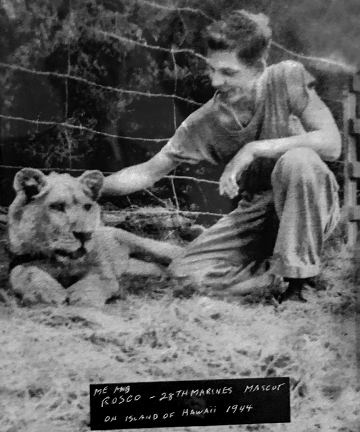
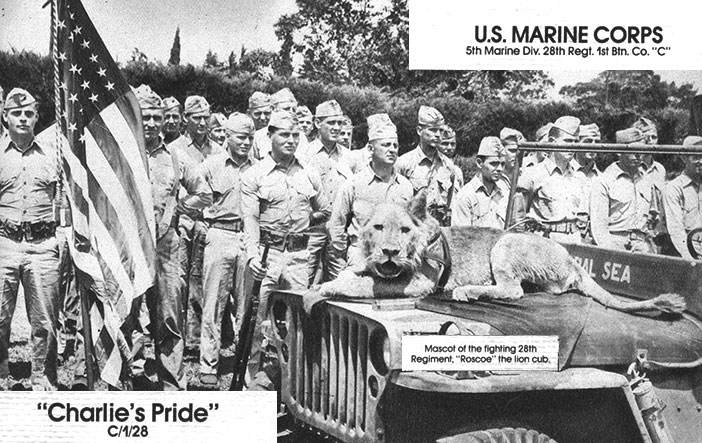
"Roscoe the Lion" Mascot 28th Marines-5th Marine Division Camp Tarawa 1945.
While working on my short history of Camp Tarawa, I stumbled on what I feel is a real human (or animal) interest story. When I first heard about Roscoe I was intrigued by the story of just how an African lion wound up as a living mascot of a Marine Regiment, how they acquired him, and how they got him aboard ship and here to Camp Tarawa on the Big Island.
So thanks to Alice Clark of the Pacific War Memorial Association's and Maile Melrose of Waimea Main Streets, Camp Tarawa oral history project, and their personal interviews with Major General Fred Haynes USMC (retired). Maile Melrose's interview was on March 19, 1995 in Waimea Hawai'i. Alice Clark's interview was on July 18, 1996 at the Little America Hotel in Salt Lake City, Utah. What you will be reading came directly from both interviews. I think you, as I have, will find the life and times of Roscoe a fascinating look back to a little bit of Marine Corps history.
So here is how General Haynes remembers Roscoe.
Roscoe was a great lion. I'm sorry he isn't with us today, 50 years later. We bought him for $25.00 from the Los Angeles zoo (Griffith Park). He was a little bitty cub. I mean he was as cute as he could be. I don't think you could buy a lion from any zoo these days.
We took Roscoe to our initial training camp which was at Camp Pendleton California and when we were ordered overseas we, much to their dismay, conned the Navy into letting us bring Roscoe to Hawai'i and we settled him in at Camp Tarawa here in Waimea. He was still a fairly small cub, but when we went to Iwo, the Navy wouldn't let us take him aboard ship, which probably good luck for him.
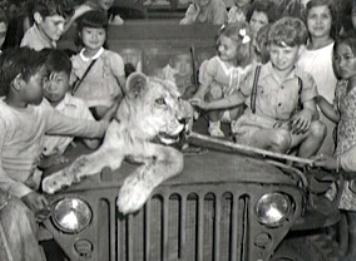
He was a great howler: he could out-howl the band! We had a good band in the Division. It was lead by Bob Crosby, Bing Crosby's brother. Then we would have these little parades over at the athletic field of about four hundred to five hundred men. Roscoe would drape himself over the hood of a Jeep and go over to the parade ground and the band would play and he would howl, or growl madly much to the discomfort of the band leader Bob Crosby. It was like being in darkest Africa to hear him let fly.
He was a big friendly guy, but we wouldn't let the average Marine go near him, only the three or four Marines who bought him and brought him to Camp Pendleton and really knew him. One or two of them had been wounded at Iwo and returned home, but there were a couple of them left when we came back and he was very friendly to them. They would go and feed him and he would growl a little bit that he was happy they were here.
There was an adjutant in our Regiment who was about five to ten years older than most of us who decided he would learn to play the bagpipes before we went to Iwo to pipe us ashore. Well he did and that lasted just several minutes and that was the last of that set of bagpipes. He got ahold of another set when we returned to Camp Tarawa. Now he was an insomniac and would play the bagpipes until two or three in the morning and of course Roscoe would join right in. So we moved both of them far enough away where they could enjoy one another's music and let the rest of us get some sleep.
In any event we came back here, and here was Roscoe weighing about 300-350 pounds and he grew and grew and got to 100% African lion size, weighed 400 pounds and ate a huge amount of food. We got meat from the Parker Ranch for him and we also took scraps from the mess halls that we would go around and get for him. He was well fed and we had him here for at least four or five months and then distemper got ahold of him, he became quite ill, and the veterinarians put him to sleep.
General Haynes' last statements were: "He is buried somewhere here on the Big Island. It was down near the camp but I wouldn't recognize the spot if we tried to find it. So that's my story of Roscoe, a great lion, and he lies here on the Big Island of Hawai'i. We ought to erect a little memorial to this male African lion that has now become part of our Big Island history."
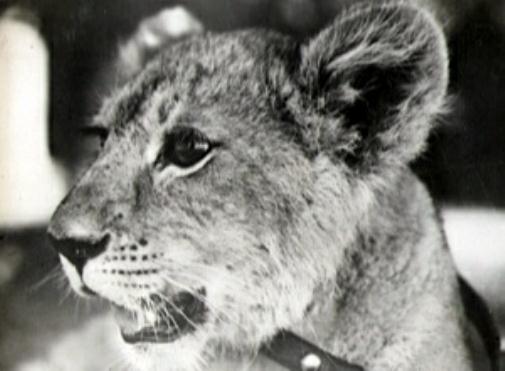
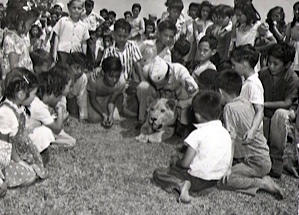
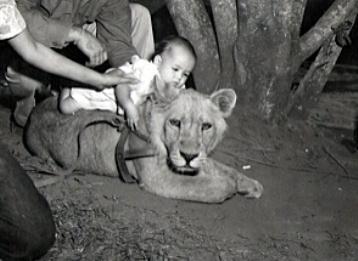
Another look at Roscoe. Pictures from the 2012 5th Marine Division Association Convention.
This web site and contents keep changing as new historic information comes along. All we had on Roscoe was the information furnished in personal interviews with General Haynes.
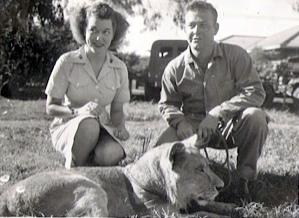
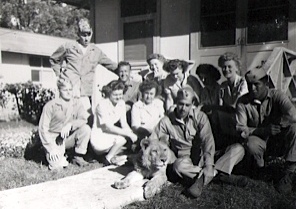
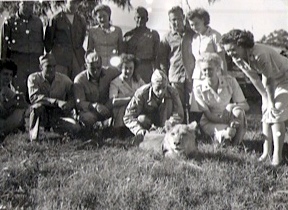
At the 5th Marine Division Association Convention Kathy Painton, our Foundation representative to the 5th Marine Division Association had a chance to talk to one of Roscoe's handlers. The gentleman agreed to share the pictures below showing a different Roscoe than the one described by General Haynes.
Seems like Roscoe never met a human he didn't like.
.
Page last update December 4, 2019
Marine John Englert with Roscoe, 1944